
Jev and Laya answer the same kinds of questions: yes/no, pick-one, and rate-on-a-scale, with probabilities instead of text. Jev is a hosted API from TypeSafe AI; Laya is an open-source model you run yourself. Most Jev vs Laya comparisons so far quote numbers measured by different people on different data. We ran both on the same items and published everything.
Jev vs Laya at a glance
| Jev | Laya | |
|---|---|---|
| Made by | TypeSafe AI | Convai Innovations |
| Licence | Closed weights, hosted API | Apache-2.0, weights on Hugging Face |
| How you run it | API: TypeSafe, Vercel AI Gateway, OpenRouter, Cloudflare | pip install laya on your machine, or the hosted Laya Studio |
| Model size | Not published | 421M parameters (English), 322M (multilingual) |
| Text per request | 32,000 tokens of state (64,000 in total) | 512 tokens (English) or 1,024 (multilingual, up to 8,192) |
| Options per choice | Up to 255 | Shares a 192–256 token budget; about 20 options recommended |
| Languages | Best in English; others supported but weaker | Router sends non-English text to the multilingual checkpoint |
| Price | $0.042 per 1M input tokens, output free | Free to run; you pay for hardware |
| Fine-tuning | Not offered | Yes; the project ships a notebook |
| API format | POST /v1/systemone | laya-serve implements the same endpoint |
Where each one runs
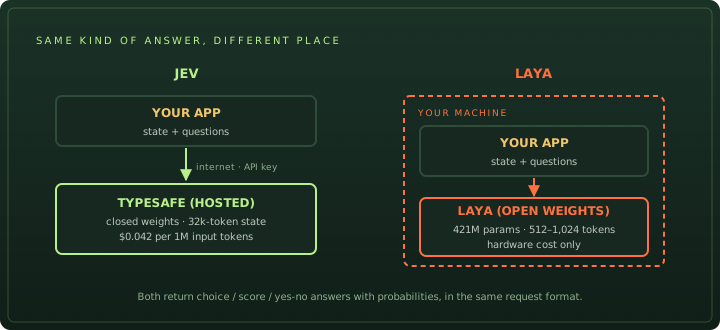
With Jev, every request leaves your infrastructure. TypeSafe says it doesn’t train on customer data, and Vercel AI Gateway can enforce zero data retention per request, but the text still travels. Laya runs wherever you install it, including offline, which settles most privacy reviews before they start. Laya also offers a hosted service in Switzerland, if you want the model without running it.
Our head-to-head test
Laya’s authors are upfront that the Jev numbers on their benchmark page were “third-party published, never measured here”. So we measured both ourselves:
- The same fixed random sample from four public datasets: Banking77 (77 intents), AG News (4 topics), Emotion (6 emotions), and SST-2 movie reviews.
- Byte-identical question wording for both models, one question per call.
- Jev through Vercel AI Gateway; Laya 0.3.20 on an Apple M3 laptop GPU, using its default router.
- All raw responses published: Jev, Laya, and the summary.
The full method and its limits are in our Jev benchmark post.
Accuracy
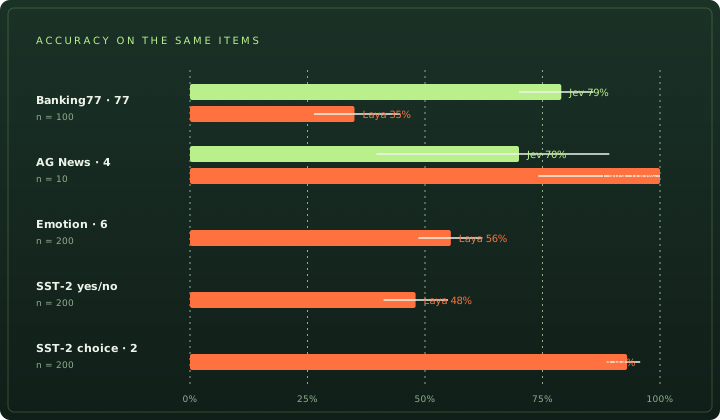
| Task | Items | Jev accuracy | Laya accuracy |
|---|---|---|---|
| Banking77 intent (77 options) | 100 | 79% 70%–86% | 35% 26%–45% |
| AG News topic (4 options) | 32 | 78% 61%–89% | 97% 85%–99% |
| Emotion (6 options) | 200 | — | 56% 49%–62% |
| SST-2 sentiment (yes/no) | 200 | — | 48% 41%–55% |
| SST-2 sentiment as a choice (2 options) | 200 | — | 93% 89%–96% |
Findings are finalised when the run completes.
The yes/no surprise
On SST-2 we first asked both models a yes/no question: “Is the reviewer’s opinion of the movie positive?”. Laya answered “no” to 98% of reviews, although about half of them were positive, which puts it at 48%: no better than a coin.
We tried rewording the question and dropping the criteria; the yes/no answers stayed near zero. Asking the same thing as a two-option choice (positive or negative) lifted Laya to 93%. If you use Laya, test its yes/no answers carefully, and consider a two-option choice instead.
Calibration
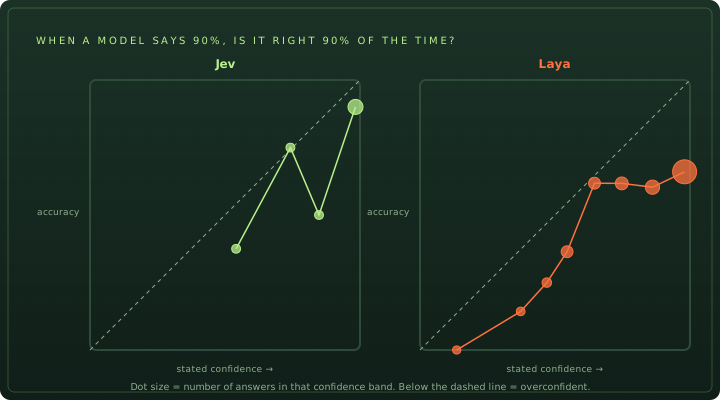
| Task | Jev avg. confidence | Jev ECE | Laya avg. confidence | Laya ECE |
|---|---|---|---|---|
| Banking77 intent (77 options) | 89% | 0.103 | 90% | 0.557 |
| AG News topic (4 options) | 97% | 0.210 | 89% | 0.077 |
| Emotion (6 options) | — | — | 82% | 0.265 |
| SST-2 sentiment (yes/no) | — | — | 97% | 0.501 |
| SST-2 sentiment as a choice (2 options) | — | — | 89% | 0.088 |
Findings are finalised when the run completes.
Speed and cost
Laya answered in 80 ms to 199 ms per question on our laptop. Jev took around 1.8 s per call, most of which is the trip over the internet and through the gateway; TypeSafe quotes 70–500 ms at the model itself. We also hit Jev’s rate limits: through our gateway account, only about three calls per minute went through, so the full test took hours. Plan for that if you batch-process with Jev.
On cost, a typical Jev call here used a few hundred to about 1,700 input tokens, a few cents per 1,000 calls (see Jev pricing). Laya costs nothing per call, but you pay for the machine, and at scale a GPU server is not free either.
Which one should you use?
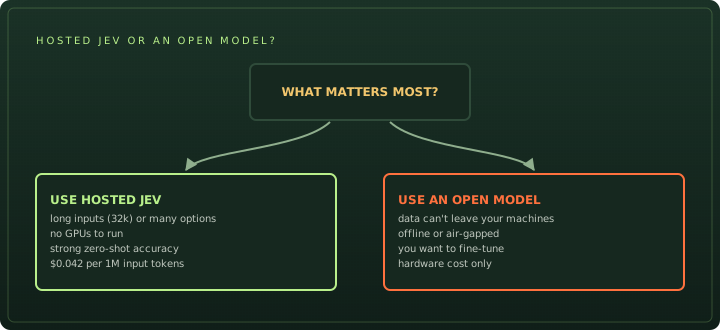
- Pick Jev if your inputs are long, your choice questions have dozens of options, you want strong zero-shot accuracy, or you don’t want to run models.
- Pick Laya if data must stay on your hardware, you need offline or very low-latency answers, your questions are short with a few options, or you’re willing to fine-tune on your own labels.
- Use both: Laya as a fast first pass, with Jev (or a person) for cases where Laya’s confidence is low.
Switching between them
Because Laya’s server speaks Jev’s request format, moving a prototype across is mostly a base-URL change. Start Laya’s server:
python -m pip install "laya[serve]"
laya-serve   # listens on port 8000
Then point your client or MCP server at it. With the System One Connector, for example, set TYPESAFE_BASE_URL to your Laya server. Two things to change as you go: the yes/no type is noul on both native APIs (the AI SDK calls it boolean), and thresholds tuned on one model won’t transfer to the other. Re-run your labelled examples after switching. For the full picture of what’s open around Jev, see Is Jev open source?
Frequently asked questions
Is Laya an open-source version of Jev?
No. Laya is an independent model from Convai Innovations that answers the same kinds of typed questions. It is released under Apache-2.0 with downloadable weights, while Jev's weights are closed. They were trained separately and give different answers.
Is Laya faster than Jev?
On our laptop, Laya answered in tens to hundreds of milliseconds, while Jev calls took around a second or two including the network round trip. The comparison isn't like-for-like: Laya ran locally, Jev over the internet with rate limits.
Is Laya more accurate than Jev?
It depends on the task. In our test Jev was far stronger on long option lists such as 77 banking intents, while Laya matched or beat it on short, simple choices. Laya's yes/no question type performed poorly unless we asked the same thing as a two-option choice.
Can I use the same code for Jev and Laya?
Largely yes. Laya's server implements the same POST /v1/systemone request format, and the System One Connector MCP server can point at either. Question names differ between SDKs (boolean vs noul), and you should re-check thresholds after switching.
Sources
- GitHub NandhaKishorM/laya (README and BENCHMARKS.md) ↗
- Laya Studio Laya vs Jev comparison page ↗
- Hugging Face convaiinnovations/laya ↗
- TypeSafe docs Models: Jev 1.13 limits and pricing ↗
- DEV Community Jev vs Laya: the same AI idea, one closed and one open ↗
- GitHub itsmostafa/typesafe-mcp (custom base URL for Laya) ↗
Our test ran on 26 September 2026 with Jev (typesafe-ai/jev) through Vercel AI Gateway and Laya 0.3.20 on an Apple M3 laptop GPU. Laya’s own figures are quoted from its repository. This site is not affiliated with TypeSafe AI or Convai Innovations.