
Jev pricing looks simple: $0.042 per million input tokens, and nothing for output. What decides your bill is how many tokens each call uses and how many calls you make. This guide shows what a call really costs, using measurements from 1,153 calls made on this site, and includes a calculator for your own workload.
The Jev price in one table
The same list price appears everywhere Jev is sold. We checked each channel on 26 September 2026:
| Channel | Input | Output | Worth knowing |
|---|---|---|---|
| TypeSafe API | $0.042 / 1M | $0 | Official endpoint. Early access sign-up at console.typesafe.ai. |
| Vercel AI Gateway | $0.042 / 1M | $0 | No markup. Per-request zero data retention. Works with your Vercel team’s gateway credit. |
| OpenRouter | $0.042 / 1M | $0 | Each response includes usage.cost. Endpoint is still marked alpha. |
| Cloudflare Workers AI | $0.042 / 1M | $0 | Called from a Worker with env.AI.run. |
TypeSafe also quotes the price as $42 per billion tokens. Same number, different unit. Because output is free, the only thing that moves your Jev bill is input.
What you pay for on each call
A token is a small chunk of text, a few characters long, that models use to measure input. Jev counts every token it has to read: the text you want judged (the state), your questions, and the option descriptions inside them. There is also a fixed overhead on every request.
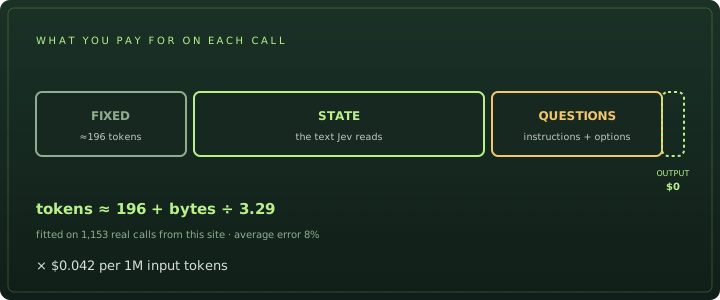
We fitted a simple formula to our own data. Take the request as JSON (state plus questions), count its bytes, and:
input tokens ≈ 196 + bytes ÷ 3.29
On 1,153 real calls the formula was off by 8% on average, and by 38% at worst. It is good enough for budgeting, not for billing reconciliation. Jev reports the exact count in every response.
Real token counts from 1,153 calls
Most pricing pages stop at the list price. Here is what calls on this site actually used, grouped by the tool that made them:
| Tool on this site | Calls | Avg. input tokens | Cost per 1,000 calls |
|---|---|---|---|
| Home page message triage (3 questions) | 719 | 635 | $0.027 |
| Playground (your own questions) | 335 | 668 | $0.028 |
| Startup idea check | 32 | 747 | $0.031 |
| Agent next-action sandbox | 21 | 506 | $0.021 |
| Draft tone check | 18 | 788 | $0.033 |
| Task routing | 15 | 572 | $0.024 |
Two patterns stand out. First, the fixed overhead dominates small requests: even a one-line message costs about 300 tokens. Second, costs stay within a narrow band. Across very different tools, the average never left the 500–800 token range, because most real inputs are a paragraph or two.
Jev pricing calculator
Pick a sample input or paste your own, choose how many questions you ask, and set a daily volume. The estimate uses the formula above and updates as you type. Nothing you paste leaves your browser.
Tool · Jev pricing calculator
Estimate what Jev will cost you
- Input tokens per call
- ≈ 634
- Cost per call
- $0.000027
- Per 1,000 calls
- $0.03
- Per month (300,000 calls)
- $7.99
At these prices the LLM costs about 3.3× as much for the same calls.
Jev: $0.042 per 1M input tokens, output free (checked 2026-09-26). Token estimate fitted on 1,153 real calls from this site; typically within ±8%. The LLM estimate assumes a 250-token prompt and about 20 output tokens per answer.
Jev vs an LLM: where the savings come from
With the calculator’s default ticket, three questions, and 10,000 calls a day, Jev comes to about $8 a month. The same workload on a text-generating model costs roughly $27 a month at small-model prices ($0.10 in / $0.40 out per 1M), about $270 at mid-size prices ($1 / $4), and around $1,400 at frontier prices ($5 / $25).
The gap has three sources:
- No output bill. An LLM has to write its answer, usually as JSON, and output tokens are the expensive ones.
- No prompt wrapper. To get a clean label from an LLM you add instructions, a format spec, and often examples. Jev’s question is already structured.
- Many questions, one read. Jev reads the state once and answers every question against it. TypeSafe’s own cookbook measured 13 questions in one call as 12.2× cheaper than 13 separate calls, with the same answers.
Be careful with headline multipliers. TypeSafe reports up to 444.6× cheaper on its own workflow tests; that figure compares against large frontier models and is the vendor’s best case. Price only matters if the answers are good enough for your task. Check accuracy on your own data first; our Jev benchmark shows how Jev did on four public datasets.
Five ways to spend less
- Send only what the question needs. Trim signatures, quoted replies, and unrelated fields. TypeSafe’s documentation notes that irrelevant state also lowers accuracy, so this saves twice.
- Ask related questions together. One call with five questions costs far less than five calls, because the state and overhead are paid once.
- Keep option descriptions short but clear. Every option in a choice question is read on every call. A 77-option intent list can triple the size of a request.
- Don’t ask twice. Cache answers by a hash of the state and questions when the same input comes back, such as retries or duplicate webhooks.
- Set a spending cap. Vercel AI Gateway budgets, OpenRouter credit limits, or your own counter will stop a runaway loop before it becomes a bill.
Is there a free tier?
As of 26 September 2026, TypeSafe does not advertise a free tier for its own API. During launch, Vercel’s model page listed Jev as free for a limited time; that promotion ended on 25 September. Gateway and OpenRouter credits you already have can be spent on Jev like any other model.
To try Jev without paying anything, use this site: the Playground and the tools include 10 free credits without an account and 100 credits a month when you sign in. One credit covers up to 5,000 input tokens, which is several typical calls.
Rate limits and plans
TypeSafe lists limits of 250,000 tokens per second and 1,200 requests per minute, with a warning that they are “adjusting dynamically” while demand is high. We saw this first-hand: when we ran our benchmark with four parallel workers through Vercel AI Gateway, most calls came back with an upstream rate-limit error. Running one call at a time with a short pause worked reliably.
If you expect bursts, add retries with exponential backoff (the official SDKs do this by default) and a queue. TypeSafe offers custom and enterprise plans with higher limits; enterprise customers can also get zero data retention on the direct API.
Ready to wire it up? The Jev AI API guide shows the calls and how to read usage from each response.
Frequently asked questions
How much does Jev cost per request?
Jev charges $0.042 per million input tokens and nothing for output. A short message with one question uses about 300 input tokens, which is roughly $0.000013. A support ticket with three questions uses about 600 tokens, roughly $0.000027, or about 2.7 cents per 1,000 calls.
Does Jev charge for output tokens?
No. Jev returns a choice, a score, or a probability instead of generated text, and all four public channels (TypeSafe, Vercel AI Gateway, OpenRouter, and Cloudflare Workers AI) list output at $0.
Is Jev free?
Not as of 26 September 2026. TypeSafe does not advertise a free tier for its own API, and the launch promotion on Vercel's model page has ended. This site offers free Jev credits for trying the model in the browser: 10 without an account and 100 a month when signed in.
Is Jev pricing the same on OpenRouter and Vercel?
Yes. TypeSafe, Vercel AI Gateway, OpenRouter, and Cloudflare Workers AI all list $0.042 per million input tokens with free output. Vercel says its gateway adds no markup. What differs is billing, rate limits, and features such as zero data retention.
How can I see what a Jev call cost?
Every response reports input tokens. The AI SDK returns result.usage.inputTokens, the native API returns usage.input_tokens, OpenRouter adds usage.cost, and Vercel's HTTP API returns the cost in providerMetadata.gateway.cost.
Sources
- TypeSafe docs Models: price, rate limits and context length ↗
- TypeSafe AI Introducing System One Models & Jev ↗
- Vercel Jev model page on AI Gateway ↗
- Vercel docs Evaluation on AI Gateway: usage and pricing ↗
- OpenRouter Jev tutorial: make your first decision call ↗
- Cloudflare Jev on Workers AI ↗
- TypeSafe docs Cookbook: parallel questions (12.2× cheaper) ↗
Prices checked on 26 September 2026. Token counts come from 1,153 live calls made through this site between 21 and 26 September 2026 via Vercel AI Gateway; we store sizes and counts, never the text people typed. This site is not affiliated with TypeSafe AI.