
Cloudflare’s Clef models answer the same typed questions as Jev (yes/no, pick one, rate on a scale) and take Jev’s request body. Unlike Jev, the weights are open, the small one is cheaper, and they read images. Cloudflare says they are also faster and more accurate. We ran Clef and Clef-flash on Workers AI against Jev on the same items we used for our Jev vs Laya test and published every response. Below, numbers we measured are marked as ours, and numbers from Cloudflare are marked as vendor claims.
Jev vs Clef at a glance
Specs as published by TypeSafe and Cloudflare, checked on 11 October 2026.
| Jev 1.13 | Clef | Clef-flash | |
|---|---|---|---|
| Made by | TypeSafe AI | Cloudflare | Cloudflare |
| Size and base | Not published | 27B, post-trained from Qwen3.8-27B | 9B, post-trained from Qwen3.5-9B |
| Weights | Closed | Open, Apache-2.0 | Open, Apache-2.0 |
| Hosted price, per 1M input tokens | $0.042 | $0.24 | $0.038 (was $0.090 until 9 October) |
| Output tokens | Free | Free | Free |
| Hosted context | 64,000 tokens, up to 32,000 of state | 65,536 tokens on Workers AI | 24,576 tokens on Workers AI (was 64K) |
| Inputs | Text | Text, up to 4 images | Text, up to 4 images |
| Where it’s hosted | TypeSafe, Vercel AI Gateway, OpenRouter, Workers AI | Workers AI, OpenRouter, or your own GPU | Workers AI, OpenRouter, or your own GPU |
| Request format | POST /v1/systemone | Same body; /ai/run/@cf/cloudflare/clef on Workers AI, /v1/systemone self-hosted | Same as Clef, with clef-flash |
A third model, Clef-omni (a 30B mixture-of-experts with 3B active parameters, $0.15 per million input tokens, 64K context), adds audio and video. We didn’t test it here; see images, audio and video below.
Our test
We used the same setup as our Jev vs Laya and Microsoft-Decision-1 tests:
- The same fixed random sample from four public datasets: Banking77 (77 intents), AG News (4 topics), Emotion (6 emotions) and SST-2 movie reviews, asked once as yes/no and once as a two-option choice.
- Byte-identical question wording, one question per call, through each model’s own request format.
- Clef and Clef-flash answered all 200 sampled items per task on 11 October 2026, through the Workers AI REST API, with no failures. Jev’s answers are from our September run through Vercel AI Gateway, which covered 100 Banking77, 100 AG News and 49 Emotion items and no SST-2. Each comparison uses only the items every model was sent.
- We score the probability each model put on its chosen answer, the same way for every model.
- All raw responses are public: Clef, Clef-flash, Jev, and the scored summary.
The full method and its limits are in our Jev benchmark post. Running all 2,000 Clef calls cost $0.15 at list prices: $0.02 for Clef-flash and $0.13 for Clef.
Accuracy
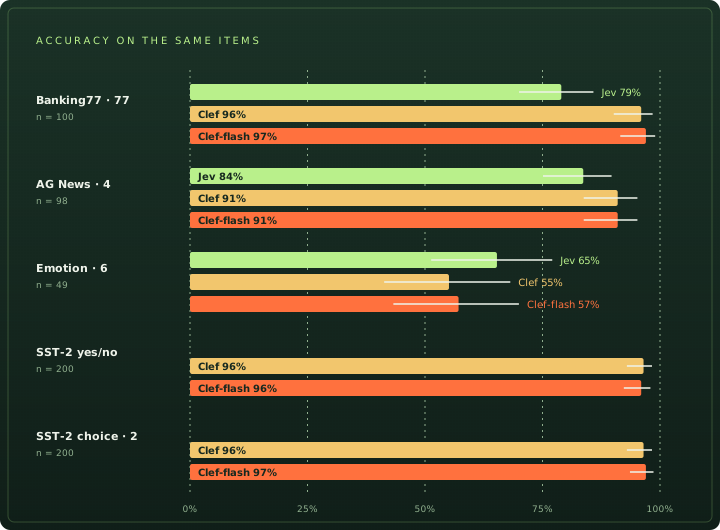
| Task | Items | Jev accuracy | Clef accuracy | Clef-flash accuracy |
|---|---|---|---|---|
| Banking77 intent (77 options) | 100 | 79% 70%–86% | 96% 90%–98% | 97% 92%–99% |
| AG News topic (4 options) | 98 | 84% 75%–90% | 91% 84%–95% | 91% 84%–95% |
| Emotion (6 options) | 49 | 65% 51%–77% | 55% 41%–68% | 57% 43%–70% |
| SST-2 sentiment (yes/no) | 200 | not run | 97% 93%–98% | 96% 92%–98% |
| SST-2 sentiment as a choice (2 options) | 200 | not run | 97% 93%–98% | 97% 94%–99% |
Many options: a large lead for Clef. On 77 banking intents, Jev got 79% right; Clef got 96% and Clef-flash 97%. The confidence intervals don’t overlap. That is a bigger gap than Microsoft-Decision-1 showed on the same items (91%).
Read that lead with one caveat. Banking77 has been public since 2020, and Cloudflare lists it among Clef’s benchmarks without saying what Clef was trained on. Of the 21 items Jev got wrong, Clef got 17 right, including several where the official label is debatable: “Where can I find my PIN?” is labelled get_physical_card, and Clef chose exactly that. A model that has seen Banking77’s training split would do this. We can’t tell whether Clef saw these test items. Your own intents won’t have that advantage.
Few options: Clef ahead on news, Jev ahead on emotions. On four news topics both Clef models scored 91% to Jev’s 84%; the intervals overlap, so this is a lead, not proof. On six emotions, Jev scored 65%, Clef-flash 57% and Clef 55%, on only 49 items. Call that one a draw leaning towards Jev.
Yes/no works. Jev didn’t run SST-2 in September, so there’s no head-to-head here, but both Clef models answered the yes/no form as well as the two-option form (97% and 97% for Clef). Laya, by comparison, fell to 48% on the yes/no form.
The 27B Clef was not more accurate than the 9B Clef-flash on any task in our test. Cloudflare’s own table puts Clef ahead of Clef-flash on Banking77 (94.2 vs 90.9 macro-F1) and far ahead on the harder CLINC150 intent set (97.4 vs 66.8), so the larger model may matter more on messier intent lists (vendor claims).
Calibration
A calibrated model that says 90% is right about 90% of the time. The expected calibration error (ECE) below is the average gap between stated confidence and actual accuracy; lower is better.
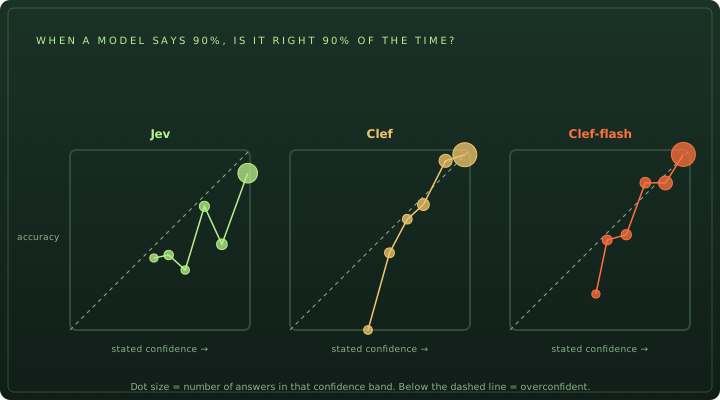
| Task | Items | Jev ECE | Clef ECE | Clef-flash ECE |
|---|---|---|---|---|
| Banking77 intent (77 options) | 100 | 0.103 | 0.069 | 0.067 |
| AG News topic (4 options) | 98 | 0.152 | 0.021 | 0.041 |
| Emotion (6 options) | 49 | 0.225 | 0.218 | 0.234 |
| SST-2 sentiment (yes/no) | 200 | not run | 0.034 | 0.029 |
| SST-2 sentiment as a choice (2 options) | 200 | not run | 0.008 | 0.021 |
- Banking77: Jev’s ECE was 0.103; Clef’s was 0.069 and Clef-flash’s 0.067. When Clef said 90% or more, it was right 100% of the time; Jev was right 93% of the time.
- AG News: Jev was the most overconfident, averaging 97% confidence while getting 84% right (ECE 0.152). Clef’s ECE was 0.021.
- Emotion: all three were overconfident by about the same amount (ECE 0.218 to 0.234).
One practical difference: Clef’s choice answers include a confidence field, as Jev’s do, but in our data it was always lower than the probability of the chosen option (0.79 vs 0.89 on average for Clef). Cloudflare’s model pages don’t say how it is computed. We scored the probabilities. If your code thresholds on confidence, re-tune it after switching.
Speed
| Task | Items | Jev median / p95 | Clef median / p95 | Clef-flash median / p95 |
|---|---|---|---|---|
| Banking77 intent (77 options) | 100 | 1.7 s / 3.9 s | 579 ms / 1.2 s | 881 ms / 5.3 s |
| AG News topic (4 options) | 98 | 1.7 s / 3.8 s | 585 ms / 1.1 s | 546 ms / 2.1 s |
| Emotion (6 options) | 49 | 1.8 s / 4.2 s | 572 ms / 1.0 s | 510 ms / 2.2 s |
| SST-2 sentiment (yes/no) | 200 | not run | 530 ms / 1.3 s | 397 ms / 1.5 s |
| SST-2 sentiment as a choice (2 options) | 200 | not run | 562 ms / 1.3 s | 423 ms / 1.1 s |
These are full round trips from our machine, including the network, not time inside the model. Clef answered in about 579 ms at the median on every task. Clef-flash was quicker on short inputs (397 ms on SST-2) but slower on the long banking prompts (881 ms), with a long tail: its 95th percentile there was 5.3 s. Jev took about 1.7 s through Vercel AI Gateway, two weeks earlier, over a different route, while our gateway account was limited to a few calls a minute. So the direction is clear (Clef was faster for us), but the size of the gap is not a fair measure.
Cloudflare’s own numbers, measured inside its own setup, are much lower: a median of 209 ms for Clef, 38.8 ms for Clef-flash and 524 ms for Jev, which it summarises as “2.5× faster” and “13× faster” than Jev (vendor claims). On 9 October Cloudflare said Clef now answers “up to 2x faster” than at launch. TypeSafe quotes 70–500 ms for Jev at the model.
Price and cost per call
All three charge only for input tokens. But each model counts tokens its own way, so the price per million is only half the story:
| Task | Items | Jev tokens / cost per 1,000 calls | Clef tokens / cost per 1,000 calls | Clef-flash tokens / cost per 1,000 calls |
|---|---|---|---|---|
| Banking77 intent (77 options) | 100 | 1687 / $0.071 | 1833 / $0.440 | 1833 / $0.070 |
| AG News topic (4 options) | 98 | 431 / $0.018 | 257 / $0.062 | 257 / $0.010 |
| Emotion (6 options) | 49 | 445 / $0.019 | 277 / $0.066 | 277 / $0.011 |
| SST-2 sentiment (yes/no) | 200 | not run | 170 / $0.041 | 170 / $0.006 |
| SST-2 sentiment as a choice (2 options) | 200 | not run | 168 / $0.040 | 168 / $0.006 |
On the long banking prompt (77 options, each with a description), Clef counted slightly more tokens than Jev (1833 vs 1687), so Clef-flash’s lower price only just evens out: $0.070 vs $0.071 per 1,000 calls. On short inputs Clef counted far fewer tokens, so Clef-flash cost about half as much as Jev per call. Clef (27B) cost about six times as much as Clef-flash, and three to six times as much as Jev.
Two Workers AI details to check before you budget. First, Cloudflare bills Workers AI in “neurons” ($0.011 per 1,000; Clef-flash is listed at 3,455 neurons per million input tokens), and every account gets 10,000 free neurons a day. The pricing page doesn’t exclude Clef from that allowance, which would cover roughly 2.9 million Clef-flash input tokens a day. Second, the hosted Clef-flash context dropped to 24,576 tokens on 9 October, less than Jev’s 32,000 tokens of state. Cloudflare says only 0.24% of requests were longer. If yours are, use Clef (65,536) or self-host Clef-flash, whose weights support longer inputs.
Cloudflare’s claims vs our numbers
| Claim | Cloudflare says | We measured |
|---|---|---|
| Banking77 | Clef 94.2, Clef-flash 90.9, Jev 79.7 (macro-F1) | Clef 96%, Clef-flash 97%, Jev 79% (accuracy, 100 items). Same direction, larger gap. |
| Wins across benchmarks | A Clef model scores highest on 7 of 10 decision benchmarks | Not tested. On our four datasets Clef led on two, trailed on one, and one had no Jev result. |
| Median speed | Clef 2.5×, Clef-flash 13× faster than Jev | Both faster than Jev for us, but our runs used different routes and dates, so we can’t confirm the ratio. Clef-flash wasn’t faster than Clef on long inputs. |
| API compatibility | “Fully compatible with Jev and SystemOne” | Our Jev request body worked unchanged on Workers AI, including noul; only the URL, token and response wrapper changed. |
| Independent leaderboards | — | Not ours either: the Hugging Face Decision Index 0.3.1 puts Jev 3rd (60.11), Clef 19th (53.08) and Clef-flash 33rd (47.61). JevBench’s capability score also puts Jev (77.1) above Clef (75.3) and Clef-flash (63.8). |
Our test and the leaderboards disagree, and both can be right. Our four datasets are short classification tasks, which is where Cloudflare says Clef is strongest. The leaderboards include reasoning-heavy sets such as GPQA and MMLU-Pro, where Cloudflare’s own card shows Clef well behind Jev (48.0 vs 78.3 on GPQA Diamond). See Jev alternatives for both boards in full.
Images, audio and video
Jev reads text only. On Workers AI, Clef and Clef-flash accept up to four images per request in an images array, as base64 PNG, JPEG or WebP (no remote URLs), up to 4 MiB and 16 megapixels each. Each image costs (width/32) × (height/32) tokens plus 3, capped at 1,024 tokens, so a full-size image costs about $0.00004 on Clef-flash. Clef-omni also takes WAV or MP3 audio and MP4 or WebM video in audio and videos fields; Cloudflare quotes about 300 ms for a 21-second clip with sound (vendor claim). We tested text only, so none of these were measured here.
If your decision depends on what’s in a screenshot, a receipt photo or a call recording, Clef is the simpler choice: with Jev you would first need another model to turn the media into text.
Open weights
Clef, Clef-flash and Clef-omni are on Hugging Face under Apache-2.0, which allows commercial use and fine-tuning. Cloudflare has not published the training data. Self-hosting needs a GPU sized for the model: 9B for Clef-flash, 27B for Clef, which Cloudflare tested on a single H200. The card’s helper code cuts inputs at 16,384 tokens by default (max_length); Cloudflare says the Clef-flash weights handle up to 256K. Served with SGLang, Clef answers at /v1/systemone, the same path as Jev. That makes it one of the few Jev-compatible options when data can’t leave your network. For how the open alternatives compare, see Is Jev open source?
API compatibility
Clef takes Jev’s request body: state, keyed questions, and the noul, choice and score types. This is the Jev call from our Jev AI API guide, sent to Clef-flash on Workers AI:
curl https://api.cloudflare.com/client/v4/accounts/$CLOUDFLARE_ACCOUNT_ID/ai/run/@cf/cloudflare/clef-flash \
  -H "Authorization: Bearer $CLOUDFLARE_API_TOKEN" \
  -H "Content-Type: application/json" \
  -d '{
    "model": "clef-flash",
    "state": "I was charged twice for my subscription. Please refund one.",
    "questions": {
      "refund": { "type": "noul", "instructions": "Is the customer asking for money back?" },
      "team": {
        "type": "choice",
        "instructions": "Which team should handle this?",
        "criteria": { "billing": "Payments and refunds", "technical": "Bugs and errors" }
      }
    }
  }'
What changes when you switch from Jev:
- URL and key.
/ai/run/@cf/cloudflare/clef-flash(orclef,clef-omni) under your account, with a Cloudflare API token that has Workers AI access. Inside a Worker, it’senv.AI.run('@cf/cloudflare/clef-flash', body). Jev is on Workers AI too, astypesafe/jev, so on Cloudflare you can switch between them by changing the model name. - Response wrapper. The REST API wraps the usual
{ model, answers, usage }in{ result, success }. Readresult.answers. Through a Worker binding you get the unwrapped object. - Limits. 1 to 64 questions per request; 24,576 tokens in total on hosted Clef-flash.
- Thresholds. Probabilities from a different model mean different cut-offs. Re-run a few hundred labelled examples and set new ones, especially if you used
confidence.
If you call Jev through the AI SDK or Vercel AI Gateway, note that Clef isn’t on Vercel AI Gateway as of 11 October 2026, so you’d call Workers AI or OpenRouter directly.
Which one should you use?
- Pick Clef-flash if your questions are classification-style (intents, topics, routing), you want the lowest hosted price, you’re already on Cloudflare, or you need images. Watch the 24,576-token limit.
- Pick Clef (27B) for inputs longer than Clef-flash allows, or to self-host the larger model. In our test it wasn’t more accurate than Clef-flash, and it costs six times as much.
- Pick Clef-omni if decisions depend on audio or video.
- Stay with Jev if your questions need reasoning more than pattern-matching (the leaderboards and Cloudflare’s own GPQA and MMLU-Pro numbers favour Jev there), you rely on the AI SDK and Vercel AI Gateway, or you’ve tuned thresholds and it works.
Whichever you lean towards, the cheapest test is your own data: send a few hundred labelled examples to both and compare accuracy and calibration, as we did. For the wider field, including OpenAI, Microsoft and Perplexity, see Jev alternatives.
Frequently asked questions
Is Clef better than Jev?
In our test on the same items, Clef and Clef-flash were more accurate than Jev on 77 banking intents (96% and 97% vs 79%) and on four news topics (91% vs 84%), and slightly behind on six emotions (55% and 57% vs 65%, within the margin of error). Both were also better calibrated on the first two tasks. The two independent leaderboards, which use many more tasks, still rank Jev above Clef, so test on your own data.
Is Clef cheaper than Jev?
Clef-flash is: $0.038 per million input tokens on Workers AI since 9 October 2026, against Jev's $0.042. Clef (27B) costs $0.24, nearly six times Jev. Output is free on all three. Token counts differ between the models, so compare cost per call on your own inputs: in our test Clef-flash and Jev cost about the same per 1,000 banking calls.
Is Clef open source?
The weights are. Clef (27B, post-trained from Qwen3.8-27B) and Clef-flash (9B, from Qwen3.5-9B) are on Hugging Face under Apache-2.0, as is Clef-omni. Cloudflare has not published the training data. Jev's weights are closed.
Can I use Jev code with Clef?
Mostly. Clef takes Jev's request body (state, keyed questions, noul/choice/score). On Workers AI the path is /ai/run/@cf/cloudflare/clef-flash with a Cloudflare API token, and the REST response is wrapped in { result, success }. Self-hosted with SGLang, Clef answers at /v1/systemone like Jev. Re-tune any thresholds after switching.
Does Clef accept images?
Yes. Clef and Clef-flash on Workers AI accept up to four base64 PNG, JPEG or WebP images per request, each counted as at most 1,024 tokens. Clef-omni also accepts audio and video. Jev accepts text only.
Sources
- Cloudflare Changelog: Clef and Clef-flash on Workers AI (1 October 2026) ↗
- Cloudflare Changelog: Clef-omni, Clef-flash price and context change (9 October 2026) ↗
- Cloudflare Workers AI model page: Clef ↗
- Cloudflare Workers AI model page: Clef-flash ↗
- Cloudflare Workers AI pricing ↗
- Cloudflare Jev on Workers AI ↗
- Hugging Face Cloudflare/clef model card ↗
- Hugging Face Cloudflare/clef-flash model card ↗
- TypeSafe docs Models: Jev 1.13 limits and pricing ↗
Clef and Clef-flash ran on 11 October 2026 through the Workers AI REST API. Jev’s answers are from our 26 September run through Vercel AI Gateway, on the same items. Prices, limits and Cloudflare’s figures were checked at the sources above on 11 October 2026. This site is not affiliated with TypeSafe AI or Cloudflare.