
For two weeks after its launch on 15 September 2026, Jev was the only model of its kind: you send some text and a typed question (yes/no, pick one, or rate on a scale) and get back probabilities instead of prose. Since 30 September, OpenAI, Cloudflare, Microsoft, Perplexity, Liquid AI, a team at AWS and several independent developers have shipped models that do the same job. Some are cheaper, some read images, and several have open weights. This page compares the main Jev alternatives on facts we could check at the source, and says who measured every number. All of it was checked on 11 October 2026.
The short answer
If Jev works for you, there is no urgent reason to leave: its accuracy is still among the best measured, and its price is mid-pack. Look at an alternative if you need something Jev doesn’t do: read images or audio, run on your own hardware, pay less per call, or stay inside a cloud you already use (Azure, Cloudflare, OpenAI). Whatever you pick, test it on a few hundred of your own labelled examples first. The two public leaderboards below disagree with each other in places, and neither one is your data.
Jev alternatives at a glance
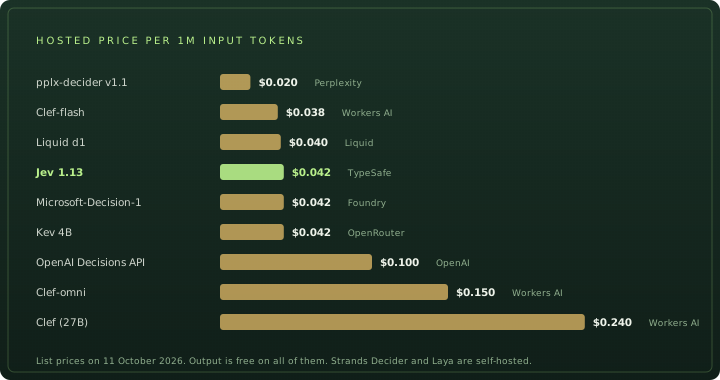
Prices are list prices per 1 million input tokens, as published by the vendor or host on 11 October 2026. Output tokens are free on every hosted option here. “Jev API” means the request body Jev uses (state plus a keyed questions object with noul, choice and score types) on the path /v1/systemone.
| Model | Made by | Weights and licence | Hosted price / 1M input | Context (tokens) | Inputs | Jev API? |
|---|---|---|---|---|---|---|
| Jev 1.13 | TypeSafe AI | Closed | $0.042 (TypeSafe, Vercel, OpenRouter) | 64,000 total, 32,000 for state | Text | Yes, the original |
OpenAI Decisions API (gpt-6-luna) | OpenAI | Closed | $0.10 (OpenAI) | Not stated by OpenAI; 1,050,000 on OpenRouter | Text, images | No: /v1/decisions, own format |
| Clef (27B) | Cloudflare | Open, Apache-2.0 | $0.24 (Workers AI, OpenRouter) | 65,536 on Workers AI | Text, images | Same body; self-hosted serves /v1/systemone |
| Clef-flash (9B) | Cloudflare | Open, Apache-2.0 | $0.038 (Workers AI, OpenRouter) | 24,576 on Workers AI | Text, images | Same as Clef |
| Clef-omni (30B MoE, 3B active) | Cloudflare | Open, Apache-2.0 | $0.15 (Workers AI, OpenRouter) | 64,000 on Workers AI | Text, images, audio, video | Same as Clef |
| Microsoft-Decision-1 | Microsoft | Closed (post-trained from Qwen3.5-9B) | $0.042 (Foundry, OpenRouter, Vercel) | 32,768 | Text | Same body on /providers/microsoft/v1/systemone |
| pplx-decider v1.1 (27B) | Perplexity | Open, Apache-2.0 | $0.02 (Perplexity, OpenRouter) | 262,144 hosted; 8,192 in the local code | Text, images | Jev-style body on /v1/decisions |
| Kev (0.8B–27B) | Jared Palmer | Open, Apache-2.0 | Self-host; Kev 4B $0.042 on OpenRouter | 8,192 (small sizes), 65,536 (27B) | Text | Yes |
| Strands Decider (2B and up) | Strands Labs (AWS) | Open, Apache-2.0 | Self-host only | 4,096 | Text | Yes |
| d1 (hosted), d1-3B, d1-omni-600M | Liquid AI | Hosted d1 closed; d1-3B and d1-omni open under LFM Open License v1.0 | $0.04 (Liquid, OpenRouter, Vercel); text-only d1:free tier | 65,536 hosted (per OpenRouter); 32,768 (3B); 16,384 (omni) | Text, images; omni-600M also audio | Yes, at /decisions/v1/systemone |
| Laya 0.4.2 | Convai Innovations | Open, Apache-2.0 | Free locally; free on Vercel AI Gateway | 512 (English); 1,024, up to 8,192 (multilingual) | Text | Yes |
Two prices moved in the last week, so older articles may quote different figures. Clef-flash launched at $0.090 and dropped to $0.038 on 9 October, when Cloudflare also cut its hosted context from 64K to 24,576 tokens. Perplexity halved pplx-decider to $0.02 with v1.1. For what a typical call costs at these rates, see Jev pricing.
Third-party rankings
Two independent leaderboards now cover decision models. They test different things, so read them side by side rather than as one score.
- Jev Decision Index 0.3.1, run on Hugging Face by Apolinário (multimodalart) and described as unofficial and community-maintained. Its full score mixes 37 public benchmarks (20%) with private tests of the same skills (50%) and private tasks from new domains (30%), corrected so 0 is random guessing. It ranks 117 models and measures accuracy only.
- JevBench, run by Florian Standhartinger at Benchmark Heaven (board v1.7.44). Each model answers 1,500 decisions. The API board ranks hosted services by a composite of intelligence, calibration, speed and cost. The open-weights board ranks by “capability” (intelligence and calibration), but only for models within 2× Jev’s cost and latency; models outside those caps get a score but no rank.
| Model | Decision Index 0.3.1: score (position of 117) | JevBench: score (rank) |
|---|---|---|
| pplx-decider v1.1 27B | 62.75 (1st) | Open board: capability 82.8, unranked (cost 6.7× Jev) |
| Jev 1.13 | 60.11 (3rd, tied for 2nd) | API board: composite 71.5 (4th of 27); capability 77.1 (2nd) |
| Kev 27B | 58.78 (6th) | Open board: capability 78.9, unranked (cost 16.4× Jev) |
| Clef | 53.08 (19th) | Open board: capability 75.3, unranked (cost 7.7× Jev) |
| Clef-omni | 49.32 (27th) | Open board: capability 58.3, unranked (over the caps) |
| Clef-flash | 47.61 (33rd) | Open board: capability 63.8 (30th) |
| Liquid d1 (hosted) | Not listed | API board: composite 73.0 (2nd); capability 74.4 (3rd) |
| Liquid d1-3B | 40.08 (53rd) | Open board: capability 49.5 (61st) |
| Microsoft-Decision-1 | Not listed | API board: composite 69.1 (6th); capability 70.8 (7th) |
| OpenAI Decisions API | Not listed | API board: composite 62.5 (8th); capability 73.5 (6th) |
| Strands Decider 2B | 21.75 (84th) | Not listed |
| Laya | 4.43 (108th) | Open board: capability 32.5, unranked (latency 2.9× Jev) |
Positions are by score order in each board’s published data on 10 October 2026; the Decision Index groups models within 0.9 points as ties, so its own display numbers can differ slightly. OpenAI’s Decisions API was scored on a different, smaller item set (600 items) than the rest of the JevBench API board. Our own test, run on four public datasets in September, put Jev at 79% and Laya at 35% on 77-way banking intents; see Jev vs Laya.
Our test: Microsoft-Decision-1 vs Jev
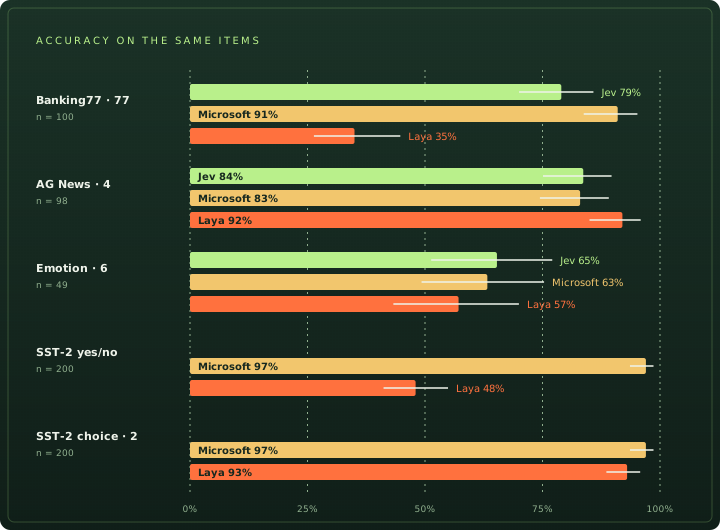
Microsoft-Decision-1 is on Vercel AI Gateway, the same route we used for Jev, so we could test it the way we tested Jev and Laya in September: the same fixed random sample from four public datasets, byte-identical questions, one question per call. Jev’s answers are from our September run; Microsoft-Decision-1 ran on 11 October 2026. Each model is compared only on items both answered. Thin ranges under each accuracy figure are 95% confidence intervals.
| Task | Items | Jev | Microsoft-Decision-1 | Laya |
|---|---|---|---|---|
| Banking77 intent (77 options) | 100 | 79% 70%–86% | 91% 84%–95% | 35% 26%–45% |
| AG News topic (4 options) | 98 | 84% 75%–90% | 83% 74%–89% | 92% 85%–96% |
| Emotion (6 options) | 49 | 65% 51%–77% | 63% 49%–75% | 57% 43%–70% |
| SST-2 sentiment (yes/no) | 200 | not run | 97% 94%–99% | 48% 41%–55% |
| SST-2 sentiment as a choice (2 options) | 200 | not run | 97% 94%–99% | 93% 89%–96% |
| Task | Calibration error (ECE), Jev / Microsoft | Median latency, Jev / Microsoft | Input tokens per call, Jev / Microsoft |
|---|---|---|---|
| Banking77 intent (77 options) | 0.103 / 0.049 | 1.7 s / 735 ms | 1687 / 772 |
| AG News topic (4 options) | 0.152 / 0.139 | 1.7 s / 699 ms | 431 / 139 |
| Emotion (6 options) | 0.225 / 0.211 | 1.8 s / 720 ms | 445 / 136 |
- Many options: Microsoft-Decision-1 was more accurate. On 77 banking intents it scored 91% against Jev’s 79%, and it was better calibrated (ECE 0.049 vs 0.103). The confidence ranges only just separate, so treat it as a real but modest lead on 100 items.
- Few options: a tie. On news topics (83% vs 84%) and emotions (63% vs 65%, only 49 items) the two are within a couple of points, well inside the noise.
- Yes/no works. Microsoft-Decision-1 got 97% on movie-review sentiment asked as a yes/no question, where Laya collapsed to 48%. Jev didn’t run this task in September.
- Same price, fewer tokens. Both cost $0.042 per million input tokens, but Microsoft counted far fewer tokens for the same text (772 vs 1687 per Banking77 call), so it cost $0.032 per 1,000 calls against Jev’s $0.071.
- Faster through the same gateway. Median round trip was 735 ms for Microsoft and 1.7 s for Jev, measured from our machine through Vercel AI Gateway. The runs were two weeks apart, so network conditions differed.
This is one small test on four public datasets, not a verdict. It agrees with JevBench that Microsoft-Decision-1 is cheaper per call, and disagrees on two points: JevBench’s larger item set scores Jev higher on intelligence (64 vs 57) and on speed (91 vs 82). Run your own labelled examples before switching.
All raw responses are public: Microsoft-Decision-1, Jev, Laya, and the scored summary. The method and its limits are in our Jev benchmark post. Clef and Clef-flash aren’t on the Gateway, so we tested them separately on Workers AI against the same Jev answers: see Jev vs Clef.
Each alternative in brief
OpenAI Decisions API
OpenAI released the Decisions API as a public beta on 6 October 2026, with gpt-6-luna as the only model. It takes text and inline base64 images, and supports predicate (yes/no), choice and score questions. The format is its own: input instead of state, and a list of named questions instead of a keyed object, so Jev code needs a small adapter. It costs $0.10 per million input tokens, about 2.4× Jev, with free output. OpenAI says it is “about 10x faster than the Responses API” (vendor claim). The full comparison is in OpenAI Decisions API vs Jev.
Cloudflare Clef, Clef-flash and Clef-omni
Cloudflare launched Clef (27B, based on Qwen3.8-27B) and Clef-flash (9B, based on Qwen3.5-9B) on Workers AI on 1 October, and Clef-omni (a 30B mixture-of-experts with 3B active) on 9 October. All three are Apache-2.0 on Hugging Face. On Workers AI they take Jev’s request body at /ai/run/@cf/cloudflare/clef (or clef-flash, clef-omni); self-hosted with SGLang, or through OpenRouter, they answer at /v1/systemone. Clef-omni is the only model here that accepts audio and video. Cloudflare reports Clef as 2.5× and Clef-flash as 13× faster than Jev at the median, and higher scores than Jev on 7 of 10 decision benchmarks, including 94.2 vs 79.7 on Banking77 (all vendor claims). The independent boards are less flattering: Clef sits below Jev on both. In our own test on the same items, Clef and Clef-flash beat Jev on banking intents and news topics and trailed slightly on emotions.
Microsoft-Decision-1
Microsoft launched Microsoft-Decision-1 on Azure AI Foundry on 9 October (US time). It is post-trained from Qwen3.5-9B, but the weights are not published. It takes text only, up to 32,768 tokens, and costs exactly what Jev costs: $0.042 per million input tokens, output free. The request body follows Jev’s (state, keyed questions, noul/choice/score) on /providers/microsoft/v1/systemone, with Azure authentication. It is also on OpenRouter and Vercel AI Gateway. Microsoft’s launch post compares it with GPT-6 Sol and other small models, not with Jev on speed. On JevBench’s API board it ranks 6th, two places below Jev; in our own test it beat Jev on Banking77 and tied on the simpler tasks.
Perplexity pplx-decider
Perplexity released pplx-decider v1 on 1 October and v1.1 on 6 October, both 27B models (about 26.1B parameters) fine-tuned from Qwen3.8-27B, with Apache-2.0 weights. v1.1 reads text and images and is the top model on the Decision Index. The hosted API is the cheapest here at $0.02 per million input tokens and accepts up to 262,144 tokens. It uses a Jev-style body (state, noul) at POST api.perplexity.ai/v1/decisions. Self-hosting is a different story: JevBench measured it at 6.7× Jev’s cost per decision on its reference setup, and the local inference code limits input to 8,192 tokens.
Kev
Kev is an independent open model family by Jared Palmer, Apache-2.0. The first checkpoint shipped on 17 September and Kev 1.0 on 1 October, in 0.8B, 4B, 9B and 27B sizes. Its server implements /v1/systemone, and the README says the TypeSafe SDK “works unchanged”. Kev 27B is 6th on the Decision Index. There is no first-party hosted API; Kev 4B is on OpenRouter at $0.042 with an 8,192-token context. Kev’s own release notes put Kev 27B slightly below Jev on its held-out index (52.3 vs 54.0, vendor claim).
AWS Strands Decider
Strands Labs, a team at AWS, released Strands Decider on 1 October: a 2B model (Qwen3.5-2B base) meant to run locally next to an agent, Apache-2.0. Gemma-4-based sizes up to 26B-A4B followed on 9 October. Run strands-decider serve and it answers at localhost:8000/v1/systemone. It is trained for a 4,096-token window and has no hosted price; we found no Bedrock listing. It is 84th on the Decision Index, which is the price of being small. The team reports a 115 ms median on an RTX 3090 (vendor claim).
Liquid AI d1
Liquid AI offers a hosted d1 model ($0.04 per million input tokens, text and images) at api.liquid.ai/decisions/v1/systemone, with a text-only d1:free tier whose limits aren’t published. On 7 October it also published d1-3B and d1-omni-600M weights; the 600M model accepts images or short audio clips. Those weights use the LFM Open License v1.0, which is free below $10 million in annual revenue, so check it before you ship. Hosted d1 ranks 2nd on JevBench’s API board, mainly on cost and speed; Liquid quotes 200–300 ms per text decision (vendor claim).
Laya
Laya, from Convai Innovations, was the first open alternative and is now at version 0.4.2. It is small (421M parameters), runs on a laptop, and its server speaks /v1/systemone. It is near the bottom of both leaderboards, and our own test found its yes/no answers unreliable. It is still useful as a free, private first pass on short, simple choices. See Jev vs Laya for our head-to-head.
Which one should I pick?
- You want the safest general choice: stay on Jev. It is top-3 on the Decision Index and top-4 on JevBench’s API board, with a 32,000-token state and 255 options per choice.
- You need images: pplx-decider v1.1 (cheapest, top accuracy on the Index) or Clef-flash if you are on Cloudflare. OpenAI’s Decisions API if you are already on OpenAI and can accept 2.4× Jev’s price.
- You need audio or video: Clef-omni is the only hosted choice. Locally, d1-omni-600M handles short audio.
- Data can’t leave your machines: with a large GPU, pplx-decider v1.1 or Kev 27B. With a small one, Kev 4B, Clef-flash or Strands Decider. On a laptop, Laya. Read Is Jev open source? for how open and hosted compare.
- You are on Azure: Microsoft-Decision-1. Same price and request shape as Jev, inside your Azure billing and compliance setup.
- Lowest cost per call: pplx-decider v1.1 hosted at $0.02, or Liquid d1 at $0.04 with a free tier for testing.
- Long inputs: Jev (32,000-token state), Clef on Workers AI (65,536), hosted d1 (65,536) or pplx-decider hosted (262,144). Avoid Strands Decider (4,096) and Laya (512–1,024 by default).
Switching without rewriting your app
Most alternatives copied Jev’s request body, so a switch is often a base-URL change. The same request works against TypeSafe, OpenRouter’s /api/v1/systemone, Liquid’s hosted d1, and a local Kev, Strands Decider or Laya server; only the URL, key and model name change:
# Jev on TypeSafe
curl https://api.typesafe.ai/v1/systemone -H "Authorization: Bearer $TYPESAFE_API_KEY" \
  -H "Content-Type: application/json" -d @request.json

# The same request.json against a local server (laya-serve and strands-decider serve use port 8000)
curl http://localhost:8000/v1/systemone -H "Content-Type: application/json" -d @request.json
If you use the AI SDK through Vercel AI Gateway, the Gateway lists Jev, Microsoft-Decision-1, Liquid d1, OpenAI’s Decisions model and Laya as decision models, so trying one is a one-line model change:
import { experimental_decide as decide } from "ai";

const result = await decide({
  model: "microsoft/microsoft-decision-1", // or "typesafe-ai/jev", "liquid/d1", "openai/gpt-6-luna-decisions", "convaiinnovations/laya"
  state: "I was charged twice for my subscription. Please refund one.",
  questions: { refund: { type: "boolean", instructions: "Is the customer asking for money back?" } },
});
Two things don’t carry over: thresholds and wording. A cutoff you tuned at 0.8 on Jev can mean something different on another model, so re-run your labelled examples after any switch. And check each vendor’s limits on options per choice and questions per call before you move a large question set.
What these numbers don’t tell you
- Leaderboards aren’t your task. The Decision Index measures accuracy only; JevBench mixes in cost and speed and puts hosted and self-hosted models on separate boards. Neither covers every model, and both change weekly.
- Vendor benchmarks are marketing until someone else repeats them. We have labelled every vendor claim above. Cloudflare, for example, reports Clef ahead of Jev on most of its benchmarks, while both independent boards put Jev ahead of Clef.
- Not every “Jev” is Jev. Some APIs resell Jev at several times its list price, and some Hugging Face models named JEV are third-party distillations. See unofficial Jev APIs before you pick a provider, and Jev architecture and RLCD for how the open alternatives work inside.
- Prices and limits are moving. Two of the prices on this page changed in the last week. We’ll keep this page updated and show the date we last checked it at the top.
Frequently asked questions
What is the best Jev alternative?
It depends on the constraint. On the Hugging Face Jev Decision Index 0.3.1, Perplexity's open-weights pplx-decider v1.1 27B scores highest (62.75 vs Jev's 60.11). On JevBench's API board, which also weighs cost and speed, Liquid AI's hosted d1 ranks second and Jev fourth. For images or audio, look at Cloudflare's Clef family; for the lowest hosted price, pplx-decider v1.1 at $0.02 per million input tokens.
Is there an open-source Jev alternative?
Yes, several. Cloudflare Clef, Clef-flash and Clef-omni, Perplexity pplx-decider, Kev, Strands Decider and Laya all publish weights under Apache-2.0. Liquid AI's d1-3B and d1-omni-600M publish weights under the LFM Open License v1.0, which has a $10 million annual revenue threshold. Jev's own weights are not public.
Which Jev alternatives work with the Jev API?
Kev, Strands Decider, Laya and self-hosted Clef serve the same POST /v1/systemone endpoint, and Liquid AI's hosted d1 uses /decisions/v1/systemone. Clef on Workers AI and Microsoft-Decision-1 on Foundry take the same request body on a different path. Perplexity uses a Jev-style body at /v1/decisions. OpenAI's Decisions API uses its own format.
Is there a cheaper alternative to Jev?
Yes. Jev costs $0.042 per million input tokens. As of 11 October 2026, Perplexity's pplx-decider v1.1 costs $0.02, Cloudflare Clef-flash $0.038 and Liquid AI's hosted d1 $0.04. Microsoft-Decision-1 is the same price as Jev, and OpenAI's Decisions API is $0.10. Output tokens are free on all of them.
Is Microsoft-Decision-1 better than Jev?
In our own test on 11 October 2026, Microsoft-Decision-1 scored 91% vs Jev's 79% on 77-way banking intents and tied with Jev on news topics and emotions. It costs the same per token but counted fewer tokens per call. JevBench's larger test ranks Jev higher overall (4th vs 6th on its API board). Microsoft-Decision-1 is text only and runs on Azure Foundry, OpenRouter and Vercel AI Gateway.
Which decision models accept images?
OpenAI's Decisions API, Perplexity pplx-decider v1.1, Cloudflare Clef, Clef-flash and Clef-omni, and Liquid AI's paid hosted d1 accept images. Clef-omni also accepts audio and video. Jev and Microsoft-Decision-1 are text only.
Sources
- TypeSafe docs Models: Jev 1.13 limits and pricing ↗
- OpenAI Decisions API guide ↗
- OpenAI API changelog (Decisions API beta, 6 October 2026) ↗
- Cloudflare Changelog: Clef and Clef-flash on Workers AI ↗
- Cloudflare Changelog: Clef-omni, Clef-flash price and context change ↗
- Cloudflare Workers AI model page: Clef ↗
- Cloudflare Workers AI pricing ↗
- Hugging Face Cloudflare/clef model card ↗
- Microsoft Microsoft-Decision-1 launch post ↗
- Microsoft Learn Use Microsoft-Decision-1 in Foundry Models ↗
- Perplexity Decisions quickstart ↗
- Perplexity API pricing ↗
- Hugging Face perplexity-ai/pplx-decider-v1.1-27b model card ↗
- GitHub jaredpalmer/kev (README and Kev 1.0 release) ↗
- GitHub strands-labs/strands-decider ↗
- Strands Agents Introducing Strands Decider ↗
- Liquid AI d1 decision model ↗
- Liquid AI Open d1 ↗
- Liquid AI docs d1 model reference ↗
- GitHub NandhaKishorM/laya ↗
- Hugging Face Jev Decision Index (multimodalart/jev-decision-index) ↗
- Benchmark Heaven JevBench: open-weights board ↗
- Benchmark Heaven JevBench: API board ↗
- OpenRouter Models API (decision models and prices) ↗
- Vercel AI Gateway models API ↗
Specs and list prices come from each vendor’s own docs, model cards or pricing pages, plus the OpenRouter and Vercel AI Gateway model APIs, all checked on 11 October 2026. Rankings are quoted from the Jev Decision Index 0.3.1 (data generated 10 October 2026) and JevBench board v1.7.44 (updated 10 October 2026). Claims a vendor makes about its own model are labelled as vendor claims. The Microsoft-Decision-1 test is our own: it ran on 11 October 2026 through Vercel AI Gateway, against Jev and Laya responses from our 26 September run. Prices change often in a new category; check the vendor page before you commit. This site is not affiliated with TypeSafe AI or any company named here.